The Stretching Fallacy: Why Pulling on "Tight" Muscles Triggers More Guarding
The Endless Cycle of Stretching
It is an almost universal ritual among athletes in Cache Valley: you walk into the gym, feel a deep, stubborn tightness in your hamstrings, lower back, or hip flexors, and immediately drop into a static stretch. You pull, hold, breathe through the discomfort, and feel a temporary window of relief.
But by the time your workout ends, or by the next morning, the exact same restriction is back.
If stretching actually lengthened muscles, the restriction would permanently resolve. The reality is that chronic muscle tightness is rarely a structural length issue; it is a neurological software issue. When you aggressively pull on a locked muscle, you aren't fixing the problem—you are often making it worse.
The Myotatic Stretch Reflex: Your Brain’s Emergency Brake
To understand why static stretching fails to solve chronic tightness, you have to understand the communication network between your skeletal muscles and your central nervous system (CNS). Intramuscular fibers contain specialized sensory receptors called muscle spindles. These spindles monitor the velocity and absolute length of a muscle change.
When a muscle is in a state of Defensive Guarding—meaning the brain has locked it down to protect a joint it perceives as unstable or previously traumatized—the threshold of these muscle spindles drops significantly.
When you force that muscle into a deep, aggressive static stretch, the muscle spindles interpret the sudden, forced elongation as a threat of tissue tearing. They immediately fire an emergency signal up the afferent pathways to the spinal cord. In a fraction of a millisecond, the CNS responds via efferent motor neurons with the myotatic stretch reflex, forcing the muscle to violently contract against the stretch.
You wanted the muscle to relax; your brain just ordered it to brace.
The Temporary Illusion of Flexibility
If stretching triggers a protective contraction, why does it temporarily feel better? Because holding a prolonged stretch forces a temporary phenomenon called Autogenic Inhibition and temporarily deadens your pain tolerance (stretch tolerance). You haven't changed the architectural structure of the tissue; you have just temporarily numbed the alarm system. Once that temporary neurological dampening wears off, the brain re-engages its defensive splint, often tighter than before to compensate for the forced instability.
The Clean Reset: Bypassing the Spindles via DNR™
To permanently eliminate chronic tightness, you must eliminate the brain's perception of threat. You cannot force a neurological handbrake to release through mechanical tension. You must use neurological safety.
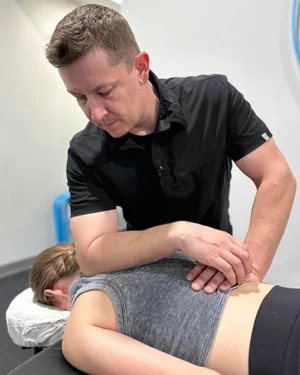
At VERVE Muscle Recovery in Logan, UT, we utilize Dynamic Neurofascial Reprogramming (DNR™) to solve the stretching fallacy.
DNR™ is a 100% passive movement protocol. Because the athlete does not actively contract any muscles, and because our clinical movements are performed at a highly controlled, non-threatening velocity, we fly completely under the radar of the muscle spindles and Golgi tendon organs. We safely guide the joint through its full structural pathways, providing the primary motor cortex with an explicit "all-clear" safety signal. The brain voluntarily drops its protective defenses, releases the neurological resting tone, and instantly restores your default mobility without a single second of forced stretching.
Clinical Sources & Scientific References
McHugh, M. P., & Cosgrave, C. H. (2010). To stretch or not to stretch: the role of stretching in injury prevention and performance. Scandinavian Journal of Medicine & Science in Sports, 20(2), 169-181.
Enoka, R. M. (2015). Neuromechanics of Human Movement (5th ed.). Human Kinetics. (Detailing the neurophysiology of muscle spindles and the stretch reflex).
Weppler, C. H., & Magnusson, S. P. (2010). Increasing muscle extensibility: a matter of increasing length or modifying sensation? Physical Therapy, 90(3), 438-449.