How Routine Recovery Will Put You Ahead of the Game
The Invisible Barrier to Performance
Most athletes in Cache Valley are incredibly hard workers. Whether you're a point guard at Utah State, a varsity wrestler at Logan High, or a dedicated dawn-patroller at Beaver Mountain, you likely have the "hustle" part down. But here is the hard truth: You don't get stronger in the gym. You get stronger while you sleep, while you eat, and-most importantly-while you recover. Training is the "stressor" that breaks you down; recovery is the "architect" that rebuilds you. If you only focus on the stress, you aren't training-you're just wearing yourself out.
The Science of the Edge: Understanding Supercompensation
To understand why routine recovery is a competitive advantage, we have to look at Supercompensation. When you train at a high intensity, your fitness level actually drops temporarily due to fatigue. If you recover properly, your body doesn't just return to its previous baseline-it overshoots it, becoming slightly stronger and more resilient than before. This "overshoot" is where the gains live. Without a routine recovery protocol, you likely train again while you are still in the "fatigue" trough. Over a season, this leads to overtraining syndrome, stagnant performance, and the "mystery injuries" that sideline athletes right before playoffs.
Why "Just Resting" is a Losing Strategy
Sitting on the couch (passive recovery) is a part of the puzzle, but for the elite athlete, it isn't enough. In a clinical setting like VERVE, we use Active Recovery Modalities to speed up the biological clock.
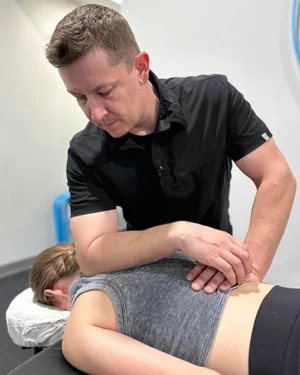
1. Clinical Soft Tissue Mobilization: The Fascial Reset
Repetitive movement-like thousands of jump shots or miles of trail running-creates "micro-adhesions" in your fascia (the connective tissue surrounding your muscles). Over time, these act like internal cobwebs, restricting your range of motion.
The VERVE Difference: We use targeted manual therapy to "unstick" these layers, ensuring your joints move through their full, intended path.
2. Red Light Therapy: Fueling the Mitochondria
We utilize the MyoLight system because it targets recovery at a cellular level.
How it works: Targeted wavelengths of light penetrate the skin to reach the mitochondria. This stimulates the production of ATP (cellular energy), which accelerates tissue repair and significantly reduces the "fire" of systemic inflammation.
3. Dynamic Compression: The Manual Lymphatic Pump
Your body's "sewage system" (the lymphatic system) is responsible for clearing out metabolic waste like lactate. The catch? It doesn't have a pump like the heart. It relies on movement.
The Tech: Our Rapid Reboot systems use sequential pneumatic compression to mechanically flush waste out of your limbs and pull fresh, oxygenated blood back in. It's like a 30-minute deep-tissue flush for your entire lower body.
The "Logan Factor": Unique Challenges in Northern Utah
Being an athlete in Logan, Utah, comes with specific environmental stressors that make routine recovery even more vital:
The Hard Floor Grind: Local basketball players at the Spectrum or high school gyms are constantly absorbing impact on hard surfaces, leading to chronic joint inflammation.
Cold Weather Stiffness: Our long winters mean muscles and tendons are often "cold" and less pliable, increasing the risk of fascial tearing during high-intensity bursts.
Altitude Recovery: Training at 4,500+ feet puts a higher demand on your circulatory system. Routine recovery helps support the oxygen-delivery cycle your muscles rely on.
Building Your Protocol: What "Routine" Looks Like
You don't wait for your car to break down to change the oil. You shouldn't wait for a "tweak" or a "pull" to visit the clinic. A pro-level routine typically looks like:
Weekly "Maintenance" Session: 30-60 minutes of manual bodywork to address emerging restrictions.
Post-Game Flush: 20 minutes of Compression and Red Light within 48 hours of a high-stress event (game or race).
Daily Mobility: Targeted stretching and hydration to maintain the work done in the clinic.
The Bottom Line
Routine recovery isn't a luxury; it's a discipline. The athletes who stay ahead of the game in 2026 aren't just the ones who play the hardest-they are the ones who recover the smartest. This is what puts you a step above the others
Ready to build your custom recovery protocol?